
The Digital Bottleneck: Why Analog is Needed
Digital computers, from your laptop to the world’s largest supercomputers, are brilliant at precision, programmability, and versatility. However, their architecture has a major flaw when it comes to the core operation of Deep Learning:
- The Von Neumann Bottleneck: Digital systems separate the processing unit (CPU/GPU) from the memory unit. To perform a calculation, data must be constantly shuffled back and forth. This data movement consumes significant time and, more critically, vast amounts of energy.
- The Power Wall: As AI models like Large Language Models (LLMs) grow in complexity, the energy required to train and run them (inference) is becoming a major economic and environmental burden. Training a single state-of-the-art model can consume more electricity than thousands of homes use in a year.
Analog computing, particularly in the context of neuromorphic and in-memory architectures, proposes a radical solution to these bottlenecks.
Unlike digital computers that use discrete steps and binary digits, analog computers represent data as a continuously varying physical quantity—such as voltage, current, or resistance.
Analog Computing: The Physics of Calculation
Unlike digital computers that use discrete steps and binary digits, analog computers represent data as a continuously varying physical quantity—such as voltage, current, or resistance.4 Calculations are performed by manipulating these physical properties directly.5
The Power of In-Memory Compute
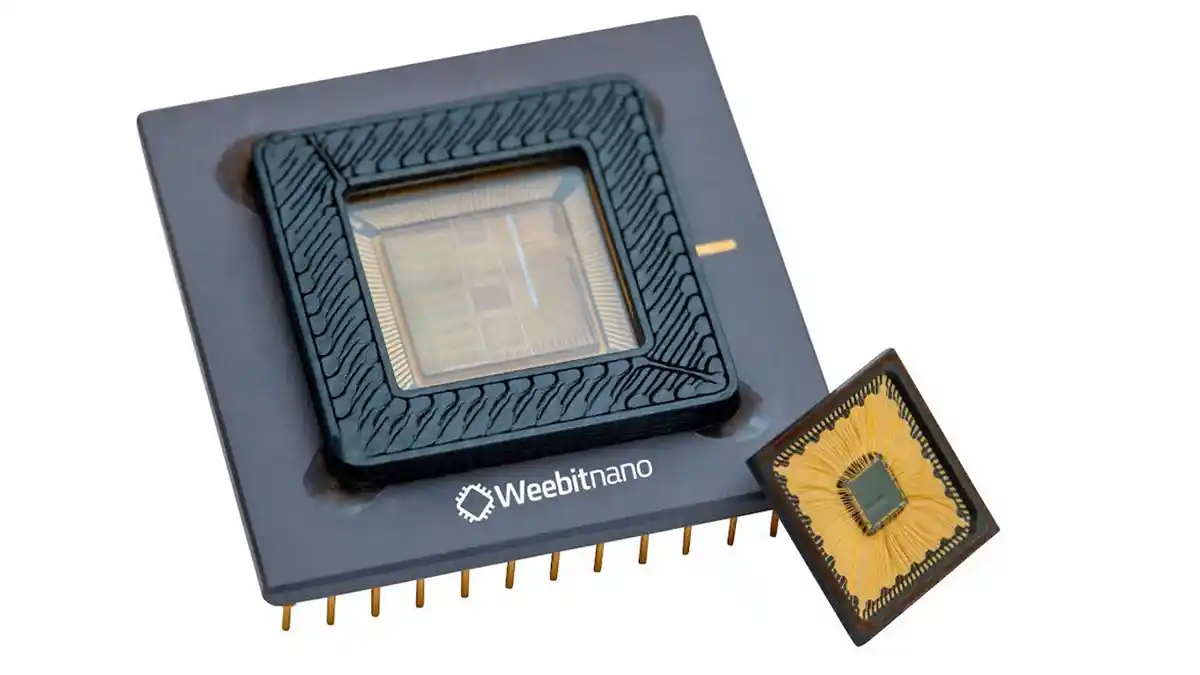
The biggest game-changer for data science is the ability of modern analog chips to merge memory and computation (In-Memory Computing).6
The core of a neural network calculation is the Matrix-Vector Multiplication (MAC), where input data is multiplied by weights and then summed up.7 In an analog chip using special non-volatile memory devices (like Phase-Change Memory or RRAM), the following happens simultaneously:
- Weights are Stored: The model’s weights are stored as the conductance (a measure of electrical current flow) in an array of memory cells.8
- Computation is Physical: When the input voltage (representing the input data) is applied across the array, Ohm’s Law (9$V = IR$) performs the multiplication, and Kirchhoff’s Law performs the summation, combining all results instantly at the output of the array.10
This approach performs the entire matrix multiplication in a single physical step, eliminating the energy and time cost of moving data, achieving:
- Massive Parallelism: All elements in the matrix are computed simultaneously.
- Ultra-Low Latency and Energy: Calculations happen at the speed of light and use orders of magnitude less energy than their digital counterparts.11
Applications in Modern Data Science and AI
The unique benefits of analog systems make them ideal for the most demanding AI workloads, specifically where speed and power efficiency are paramount.12
1. High-Speed AI Inference at the Edge
Analog chips are perfectly suited for Edge Devices (smartphones, IoT sensors, autonomous vehicles).13 Running AI inference (the application of a trained model) directly on the device requires minimal power. An analog accelerator can process live video feeds or audio signals instantly, enabling:
- Real-Time Image Recognition on a security camera with a tiny battery.
- Voice Assistant Processing with ultra-low power consumption.
2. Accelerated Neural Network Training
While challenging, researchers are developing hybrid analog-digital systems to accelerate the notoriously power-hungry training process. For many Deep Learning models that can tolerate lower precision (e.g., $8$ to $10$ bits instead of $32$), analog provides a speed boost for the bulk of the MAC operations, dramatically cutting training time and cost.
3. Solving Continuous Systems
Traditional analog computers were the masters of solving complex Differential Equations, which model continuous physical phenomena (fluid dynamics, financial markets, weather systems).14 For data scientists working in scientific computing, these modern analog systems can simulate complex models faster than even the most powerful digital supercomputers.
Challenges on the Road Ahead
The analog renaissance is not without its hurdles:
| Challenge | Description |
| Precision and Noise | Analog systems are inherently less precise than digital systems. Physical variations in chip manufacturing and electrical noise can affect the output. This is acceptable for deep learning, but problematic for high-precision tasks (like banking). |
| Programmability | Historically, analog computers were special-purpose—hardwired for a specific problem. Modern analog systems are more reconfigurable, but still lack the general-purpose flexibility and ease of programming that digital systems offer. |
| Training Complexity | The process of training a model directly on an analog chip is more complex than simple inference, requiring innovative algorithmic approaches to handle the precision mismatch between the forward pass and the backpropagation step. |
The Future: A Hybrid World
The most likely future is not a complete analog takeover, but a digital-analog hybrid. The versatility and high precision of digital computers will continue to manage control, logistics, and data storage, while specialized analog accelerators will be integrated to handle the core computational heavy-lifting of AI and data processing.
By leveraging the physics of computation, analog technology promises to break the current power and speed bottlenecks, pushing the boundaries of what is possible in real-time, large-scale data science and ushering in the next era of energy-efficient AI.15.